
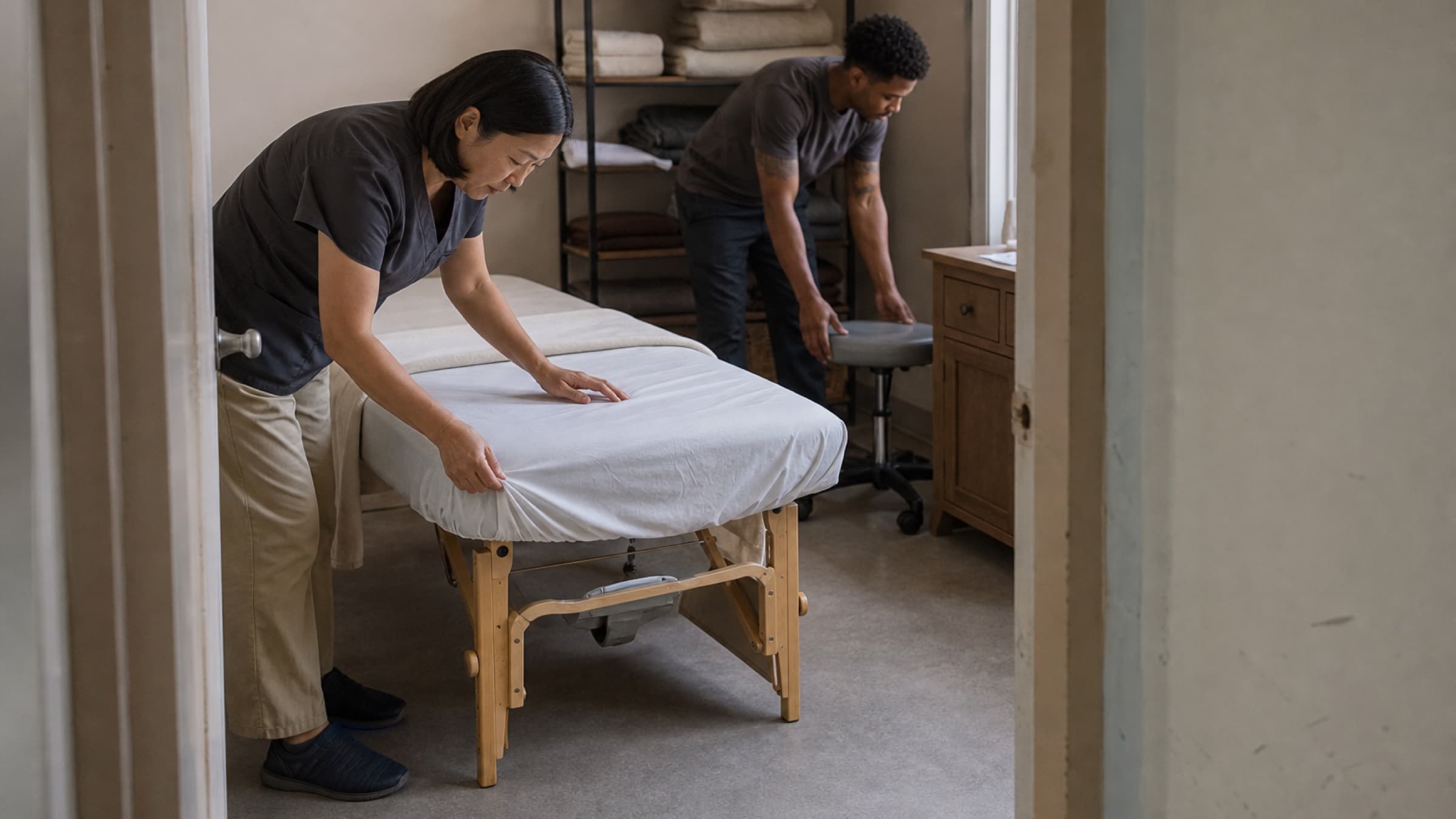
Two calendars can be right and the room can still be wrong
Practitioner availability answers one question: who is able to work?
Room availability answers another: where can the appointment happen?
Those questions are easy to collapse when you work alone. If you are free, your room is probably free too. As soon as a second practitioner shares the space, that assumption stops working.
Picture a massage therapist and an acupuncturist who both work Tuesdays. Each has a separate schedule. At 3 p.m., both appear available. But if both services require the same private room, the practice only has capacity for one appointment.
The fix is not a more complicated color system or a group chat where everyone announces bookings. It is to give the room a place in the scheduling decision. A time should only be offered when both the practitioner and the space are available.
Make the room a resource, not a note
Practices often begin by writing a room name in the appointment notes. That helps people know where to go after the booking exists, but it does not stop another person from claiming the same space.
List each constrained space as something that can be booked. Use names your team recognizes immediately, such as:
- Front treatment room
- Massage room
- Acupuncture room
- Quiet consultation room
Avoid calling everything Room 1 and Room 2 unless those names are already clear in daily use. The point is not to create a perfect naming system. It is to let someone glance at the day and know which physical space is spoken for.
Then decide which appointments truly need that room. A virtual follow-up does not. A phone consultation may not. A treatment requiring a table, sink, specific equipment, or acoustic privacy probably does.
This distinction protects capacity. You do not want an online appointment quietly reserving the only treatment room, and you do not want an in-person service booked without one.
Give the room its own setup and reset time
An appointment may end at 2:50, but the room may not be ready at 2:50.
There may be linens to change, surfaces to clean, equipment to return, notes to finish, or a window to open for a few minutes. If the next practitioner is expected to begin at 3, the handoff can become a silent race.
Choose a realistic turnover time for each kind of service. Ten minutes may be enough for a conversation-based session. A treatment room with linens and equipment may need longer. Build that time into the schedule instead of hoping it appears between clients.
It also helps to agree on what "ready" means. A simple room reset might include:
- Used linens are removed and contained.
- Shared surfaces are cleaned according to your normal protocol.
- Equipment is returned to its usual place.
- Supplies are replenished to the agreed minimum.
- Personal notes, cups, and devices leave with the practitioner.
The checklist should be short enough to use on a full day. Its job is to make the next person's starting point predictable, not to turn every handoff into an inspection.
Agree on the handoff before the awkward day
Most room friction is small. Someone runs five minutes late. A table is left at the wrong height. The last clean sheet disappears. Small problems become personal when the team has never agreed on what should happen.
Set a few plain rules while the room is calm:
- Who resets the room after an appointment?
- Where do used and clean linens go?
- Which supplies are shared, and who replaces them?
- How much turnover time belongs between bookings?
- What happens when a session runs late?
- How does someone report damage or a missing item?
For a late session, the best rule is usually early communication. If you know the room will not be ready, tell the next practitioner before their client arrives. That gives them a chance to use another suitable space, adjust the welcome, or make a clear plan with the front desk.
Avoid solving the problem in front of clients. A quiet message five minutes earlier protects the sense that the practice is prepared.
Plan for the room to be unavailable
Rooms sometimes need repairs, deep cleaning, new equipment, or a day with no heat or water. If the room only exists as an informal agreement, people may keep booking it while it is out of use.
Treat a room closure the same way you treat practitioner time off. Block the space as soon as the closure is known, review affected appointments, and decide which ones can move to another room without changing the quality or privacy of the service.
Do not assume every room is interchangeable. Check:
- Privacy and sound travel
- Accessibility
- Table or equipment needs
- Sink and storage access
- Enough space for the client and practitioner to move safely
- Whether the client already received arrival instructions tied to that room
If an appointment must move, tell the client only what they need to know. "We will meet you in the front treatment room today" is usually enough. The internal scheduling problem does not need to become their problem too.
Run a five-minute room check each week
A short weekly check catches shared-space problems before the busiest day does.
Open the coming week and look for times when two practitioners are working in person. Confirm that each appointment has a suitable room and that turnover gaps are still present. Then scan for closures, unusual services, or a practitioner working outside their usual hours.
You can also use the check to notice patterns. If the same room is booked from open to close while another sits empty, the issue may be equipment or setup rather than total space. If one practitioner regularly waits for a handoff, the turnover gap may be too short. If clients are moved often, your service-to-room assumptions may need an update.
The goal is not to manage every room minute by minute. It is to make the physical limit visible enough that the schedule respects it.
For practices using room scheduling, Stillpoint lets you set up active treatment rooms inside each location and view them alongside practitioner availability. Booking capacity is capped by the rooms that are actually available, so a free practitioner does not accidentally create a second claim on the same space.